


Lisbon in September: a practical guide to discovering the city
September is one of those months when Lisbon seems to find the right balance. The days remain warm and bright, but the city gradually begins to recover a quieter pace after the summer peak. The climate normals for Lisbon point to an average maximum temperature of 26.6 °C and an average minimum of 17.6 °C, making this an excellent month for walking, dining on a terrace, and discovering the city outdoors.
Staying in the center changes the way you experience Lisbon
Hotel Portuense is located in the center of Lisbon, in a historic area next to Rossio and Restauradores, very close to Avenida da Liberdade and within comfortable walking distance of Baixa and Chiado. The location allows combining walking trips with an extensive network of transport, restaurants, cafes, shops, and services.
The advantage is simple: less time commuting and more time in Lisbon.
Rossio belongs to the Green Metro Line and Restauradores to the Blue Line. For those arriving by plane, the Aeroporto station is on the Red Line and the network allows you to reach the center with connections. Rossio Station is also just a few minutes away, a particularly useful point for a train getaway to Sintra.
A first walk through the city’s history
Rossio, officially Praça D. Pedro IV, has been one of the city’s main meeting places for centuries. From here it is easy to follow the Baixa Pombalina towards Praça do Comércio.
Much of this area tells one of Lisbon’s most important stories. After the 1755 earthquake, the Baixa was rebuilt according to an urban project that gave rise to the current Baixa Pombalina, characterized by geometric streets and large squares.

Praça do Comércio – by the Tagus and in the former space associated with the royal palace.

Chiado and Largo do Carmo – one of the most elegant and cultural areas of the city, where the ruins of the Carmo Convent recall the 1755 earthquake in a particularly visible way.
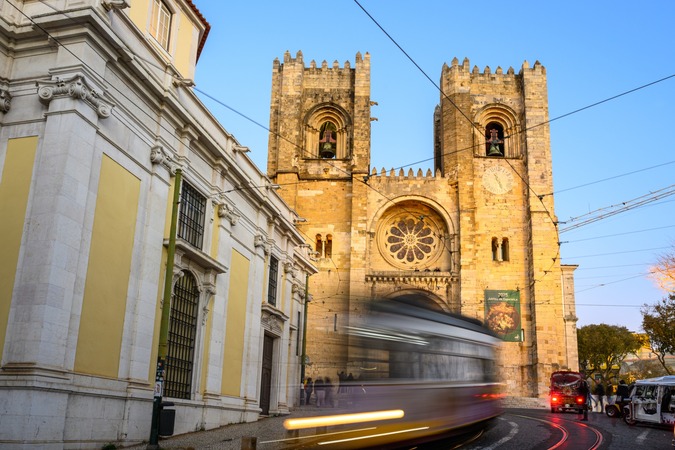
Lisbon Cathedral and Alfama – to step into an older Lisbon, made of narrow streets, staircases, viewpoints, and traditional houses.
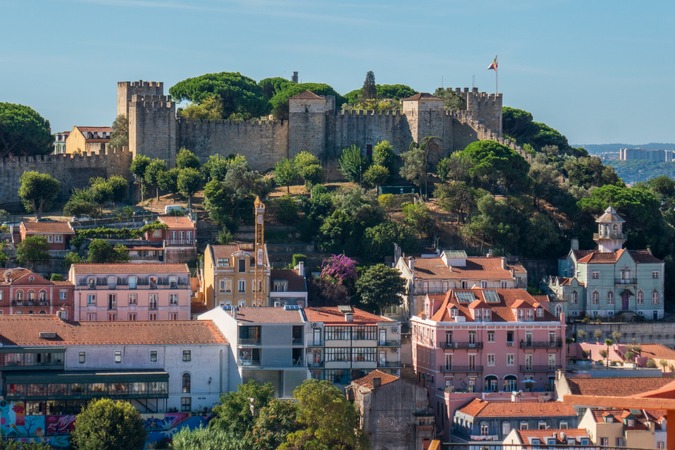
São Jorge Castle – it is worth it as much for its history as for the panoramic view over Lisbon and the Tagus.
Belém: Lisbon facing the world
Those with more time should reserve a few hours for Belém. Here you will find two of the city’s most important monuments: the Jerónimos Monastery and the Belém Tower, classified as World Heritage by UNESCO.
The Monastery is one of the great references of the Manueline style, while the Belém Tower is deeply linked to the defense of Lisbon’s entrance and Portuguese maritime history. It is an area that helps understand the historical relationship between Lisbon, the Tagus River, and the Portuguese maritime expansion.
Where to try Portuguese food near Hotel Portuense
Casa do Alentejo — located on Rua das Portas de Santo Antão itself, in the historic Alverca Palace, it is a good opportunity to get to know dishes linked to Alentejo gastronomy in a space that, by itself, deserves a visit.
Solar dos Presuntos — also on Rua das Portas de Santo Antão, it is a traditional name in Portuguese restaurants. For dinner, it is wise to book in advance.
During your stay, it is worth looking for some classics: bacalhau à Brás (shredded cod), polvo à lagareiro (octopus), seafood rice, bifana (pork sandwich), caldo verde (kale soup), roasted chicken, and fresh fish dishes.
Practical tip: in Portuguese restaurants, bread, cheese, butter, or olives placed on the table may be charged when consumed. If they do not interest you, simply do not consume them and ask for them to be removed.
And the sweets?
There is one that needs no introduction: the pastel de nata. Near the hotel, the historic Confeitaria Nacional, in Praça da Figueira, has existed since 1829 and is an excellent point to discover traditional Portuguese sweets.
Those who visit Belém can take the opportunity to continue the sweet experience in that area. And those departing from Rossio Station to Sintra should add two words to the list: queijadas and travesseiros.
Practical tips for September
Lisbon remains busy in September, so booking the most popular monuments and some restaurants in advance helps avoid queues and sold-out times.
Comfortable footwear is essential. The famous Portuguese pavement (calçada) is beautiful, but the hills, stairs, and polished pavement make a good pair of sneakers much more useful than they seem.
During the day, water, sunscreen, and light clothing still make sense. For the beginning and end of the day, a light long-sleeved garment can be useful.
And there is a particularly simple rule: do not try to see all of Lisbon at once. The city works best when there is time to stop at a cafe, look at an old building, enter a street without a plan, or spend a few minutes at a viewpoint.
Hotel Portuense: a practical base in the heart of the city
For those looking to control costs without giving up a privileged location, staying in the center can represent a real advantage.
At Hotel Portuense, the proposal is simple: a family atmosphere, a central location, and a comfortable stay to rest between two days of discovery. In September, when much of Lisbon is still experienced in the street, having Rossio, Restauradores, Baixa, Chiado, and Avenida da Liberdade nearby means starting to get to know the city as soon as you leave the hotel.
Lisbon is at your doorstep. The rest can be discovered on foot.